


Where do we stand, when do we walk, and is my phone going to turn my kid into an orange smear under those lights? If you have a senior playing a fall sport in Kitsap County, that is the exact question in your head right now, and it deserves a real answer instead of a shrug.
Senior night photos in Kitsap County are harder than they look for one simple reason: the ceremony happens at the worst possible time for a camera, in the last light of a late October evening, under stadium lights built for referees rather than portraits. The fix is not a better phone. The fix is knowing which ten moments matter, where to be for each one, and which single photo to take before the lights come on. This guide covers all three, written by a Bremerton senior photographer who has photographed seniors on their own school’s field.
What are the senior night photos you actually need?
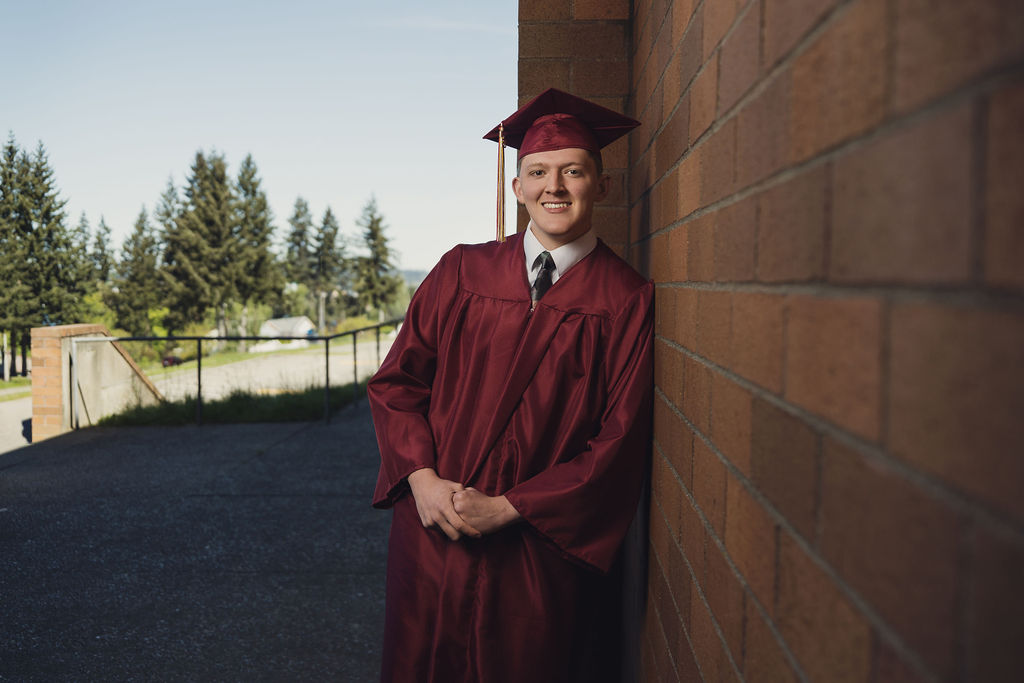
Ten moments, plus one. The ten happen during the ceremony and the game: the walk out with your parents, the flowers and the handoff, the hug at midfield, the name over the loudspeaker, the team lined up, the jersey and the number, the senior with the coach, the senior with their people, the poster, and the last look at the field. The one that comes before all of them is a daylight portrait of your senior and both parents on the field or in front of the school, taken before the ceremony and before the sun goes down. That is the frame you will actually print.
The rest of this guide is the how. We will start with when senior night happens here, because the clock is the whole problem.
When is senior night in Kitsap County?
For fall sports, senior night is usually the last home game of the regular season, which in Kitsap County lands in the second half of October. Central Kitsap’s football senior night this year fell on October 16, their last home game, and the football senior nights at the county’s other public high schools land in that same stretch of October. Volleyball, soccer, cross country and cheer have their own nights in the same stretch, often in a gym, which changes the light problem completely.
The WIAA football calendar frames the season: first practices were allowed on August 19, state semifinals are November 28, and the state finals are December 4 and 5 at Husky Stadium. A team on a deep playoff run plays into late November. For everyone else the season, and the senior night, ends in October. Winter sports hold senior nights in late January and February, indoors, and spring sports in May, when sunset is after 7:30 pm and the whole ceremony happens in daylight. If you have a spring athlete, your light problem is already solved.
Your school sets the date weeks in advance. Ask the athletic office or the booster club in September, because the date is fixed before the schedule says so, and grandparents need time to plan.
Why take one photo before the lights come on?
Because the sun sets before kickoff. Varsity football games here typically kick off at 7 pm, and here is what the sun is doing on Friday nights this fall, according to the U.S. Naval Observatory for Bremerton.
| Friday | Sunset | Dark enough for the lights |
|---|---|---|
| October 2 | 6:47 pm | about 7:18 pm |
| October 16 | 6:20 pm | about 6:51 pm |
| October 30 | 5:56 pm | about 6:28 pm |
| November 6, after the clocks change | 4:45 pm | about 5:18 pm |
Read that table like a photographer. In early October the pregame ceremony happens in soft, fading light, which is lovely. By the middle of the month the sun is gone forty minutes before kickoff and the walk happens under the lights. By November it is fully dark before most families have found parking. Stadium lights are bright enough to play under and terrible for faces: they come from high above, they put shadows in every eye socket, and they are often a color that makes skin look orange or green depending on the bank your senior is standing under.
So arrive early. Ninety minutes before kickoff is the sweet spot, which on a 7 pm game means 5:30 pm. The team is warming up, the stands are nearly empty, and the sky is still doing something. Walk to the edge of the field, or to the school sign out front, and take one deliberate photo of your senior with both parents, and then one of your senior alone in uniform. Backs to the brightest part of the sky, faces toward you, nobody squinting. That is the photo that goes on the wall in December. Everything that follows is the memory of the night; this is the portrait of the person.
The 10 senior night moments to get
Give one parent the phone for the ceremony. The other parent walks. Trading off mid ceremony loses both. If grandparents or a sibling can hold the camera for the walk itself, even better, because then both parents are in it, which is the entire point of the night and the reason we keep saying to take a few photos with your senior, not just of them.
1. The walk out
The announcer calls the name, the senior steps out with the people who drove to every practice, and they walk the length of the field or across the track. Stand at the point where they will stop, not where they start, so they walk toward you. Hold the phone steady with both hands, keep the senior in the center, and take a burst instead of single frames.
2. The flowers and the handoff
Many schools hand each senior a flower or a small bouquet, and most seniors immediately hand it to their mom. That handoff is the better photo. Be ready for it instead of the moment the flower arrives.
3. The hug
Someone cries. Often it is Dad. Do not put the phone down because you are also crying; this is the one you will want most. Take it slightly wide so you catch the whole embrace and the uniform number together.
4. The reaction to the name and the plans
Many schools read a short bio: the parents’ names, what the senior plans to do next, a favorite memory. The senior’s face during that read, part proud and part mortified, is a real frame. So is the parents’ face hearing their own names over a loudspeaker.
5. The team lined up
Before or after the walks, the seniors stand in a row with their parents behind them, or the whole team lines up along the sideline. Step back and take the wide frame from an elevated spot in the stands if you can. It is the only photo of the night that shows the whole class.
6. The jersey and the number
A tight frame from behind, name and number filling the screen, with the lights and the crowd soft behind it. Take this one before the game, while the jersey is clean, and again after, when it is not. Both tell the truth.
7. The senior with the coach
Coaches rarely get into the photos, and years from now your senior will want this one. Ask right after the ceremony, before the coach’s attention turns to the game. It takes ten seconds.
8. The senior with their people
Teammates, the best friend in the student section, the little sibling in the oversized jersey. These happen in the ten minutes after the ceremony and before kickoff, so stay down near the track instead of climbing back to your seats right away.
9. The poster
Someone made a poster, or the booster club hung a banner on the fence with the senior’s face on it. Photograph your senior next to it, holding it, pointing at it, or pretending to be embarrassed by it. Also photograph the poster alone, straight on, so you have a clean record of it after it comes down.
10. The last look at the field
After the final whistle, before the helmets come off, there is a moment when every senior stops and looks at the field. From the stands with the lights blazing, that frame is mostly silhouette and glare, and that is fine. It is a feeling, not a portrait. You already took the portrait at 5:30.
How do you get a usable photo under stadium lights with a phone?
You work with what the light gives you and stop fighting it. Here is the short list that saves most senior night photos.
- Turn the flash off. From more than a few feet away a phone flash lights nothing but the backs of the people in front of you and tells the phone the scene is brighter than it is.
- Tap on the face, then slide the brightness down a touch. Phones expose for the bright lights and turn faces dark. Tapping on your senior tells the camera what matters, and nudging exposure down keeps the uniform from blowing out to white.
- Use the main camera, not the zoom. Zooming in on most phones throws away quality in low light. Get physically closer instead, which on senior night usually means being down at the track rather than in row twenty.
- Brace your elbows and take bursts. Low light means slower shutter speeds, which means blur. Hold the phone with both hands, tuck your elbows in, and hold the button down for a burst during the walk. One of ten will be sharp.
- Watch where the light banks are. If the brightest bank is directly behind your senior, your phone sees a silhouette. Step a few feet to the side until the light lands on them rather than behind them.
- Skip night mode for anything moving. Night mode is brilliant for the poster and the lineup, where nobody moves, and useless during the walk, where it blurs everyone.
- Record ten seconds of video of the walk. Then take photos. The video catches the announcer’s voice and the crowd, which no photo can, and you can pull a still from it later if the photos missed.
One more honest note: the color under the lights will look strange, and that is the lights, not you. Our editing team corrects stadium light color in the sports frames we photograph, but a phone photo straight from the night will lean orange or green. Converting a favorite frame to black and white hides that completely and often looks better.
Where should parents stand, and what are the rules?
Ask before the night. Every Kitsap school handles the sideline differently, and the answer usually comes from the athletic director or the booster club running the ceremony. At most stadiums the walk happens on the track in front of the home stands, the seniors and parents gather near one end zone, and spectators are expected to stay in the stands or at the fence. Field access during the game is for coaches, officials and credentialed photographers, so plan on photographing the ceremony from the first rows or the fence line.
The practical rule is simple. Do not stand where the walk is headed, do not block the family behind you, and do not step onto the field unless someone from the school waves you on. The ceremony takes fifteen minutes. The good frames come from being in the right place at the right time, not from being closer than you are allowed to be.
Should you hire a photographer for senior night?
Usually not for the ceremony itself, and we will tell you that honestly. The walk is a family moment best caught by a family member or the school’s own photographer, and the light is what it is. What we recommend instead is a sports senior session on the field in daylight, planned around the sunset, where your senior gets the uniform, the ball, the cleats and the field in soft, flattering light, along with the other looks that tell the rest of their story. That is the session that produces the portrait, and senior night produces the memories. The two belong together on the wall.
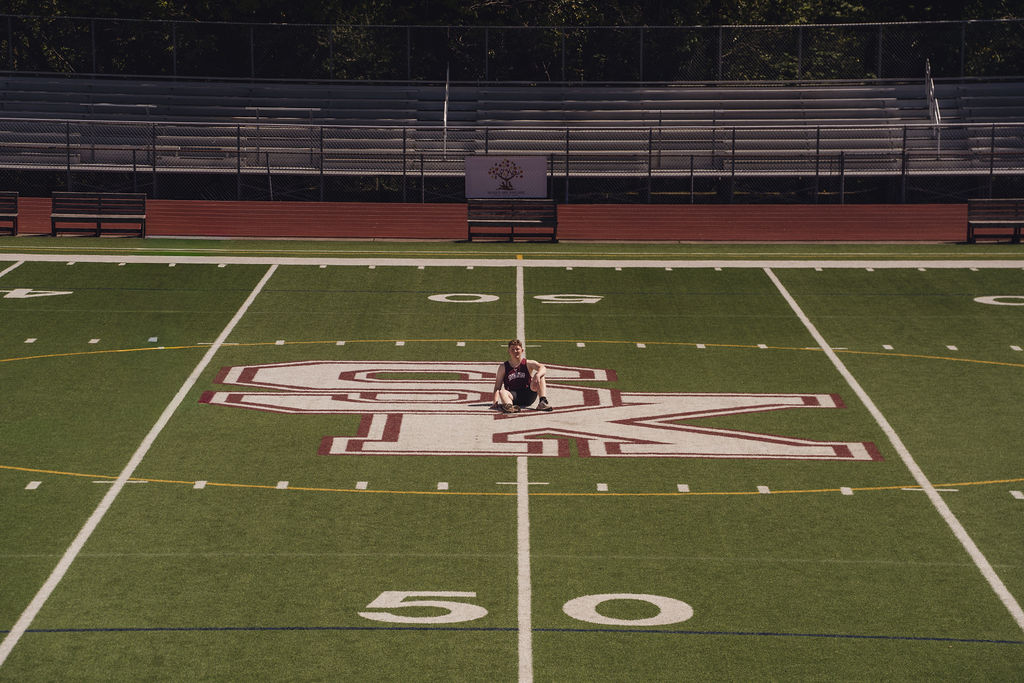
Our sports senior sessions are built exactly that way: one area, up to five looks and up to five backdrops across about two hours, fully guided posing so nobody has to know what to do with their hands, and a reveal about a week later, on a video call with our reveal team, where you see the finished gallery for the first time. The session fee is $299 and includes an eleven by sixteen print, a $300 value on its own. See how we plan a sport around a personality in sports senior pictures in Kitsap County, what to bring in what to wear for sports senior pictures, and how a real one came together in Zach’s personalized Bremerton senior session, which included his school and its football field. The jersey, the helmet and the game ball are also some of the best props a senior can bring; our thoughts on that are in senior picture props that feel like you.
If your senior loves the look of the field at night, that is a separate conversation and a fun one. We photograph city lights and blue hour sessions all fall, and the same ideas carry to a lit field with permission from the school. Start with Senior Pictures After Dark Hit Different and Stay Past Sunset. The Sky Has a Second Act.
What should you bring to senior night?
- A fully charged phone with storage cleared the night before. Senior night is not the night to see the storage full message.
- A small portable charger. Cold nights drain batteries faster.
- Tissues, for reasons already covered.
- Layers. Stadium bleachers in late October in Kitsap are cold by the second quarter.
- The flowers, if the school asks families to provide them, and a safety pin for the boutonniere or corsage some schools use.
- Your senior’s clean jersey or a second shirt if the school plans a group photo after a muddy game.
- A printed copy of the bio you submitted, so you can hear it read and keep it afterward.
- Grandparents. Seriously. Book their ride early.
Senior night photos in Kitsap County: frequently asked questions
What time should we arrive for senior night?
About ninety minutes before kickoff. That gives you parking, the daylight portrait, and a calm walk to the staging area before the announcer starts calling names.
Who walks with the senior on senior night?
Usually both parents or guardians, and many schools welcome a sibling or grandparent as well. Ask your booster club what your school allows and tell them early if your family needs a different arrangement.
Can we get on the field for photos?
Only when the school invites you, typically during the ceremony itself. Outside of that, photograph from the fence line or the first rows. The daylight portrait before the game can happen at the field edge or in front of the school without anyone needing to step on the turf.
Why do my senior night photos look orange?
Stadium lights are a different color than daylight and phones struggle to correct for them. Tap to expose on the face, and if the color still looks off, convert the frame to black and white.
Is senior night the same as senior pictures?
No. Senior night is a ceremony photographed in the moment, under hard light. Senior pictures are a planned portrait session in good light with multiple looks, and the yearbook photo usually comes from that session. The Class of 2027 Kitsap senior photo planner has the deadlines and the timeline.
When should a fall athlete book their senior session?
Late summer, before the season starts, or on a bye week in September when the light is still long. Our senior year timeline for Kitsap parents maps the whole year month by month.
Can you photograph my senior at their actual game?
Game coverage depends on the school’s sideline rules, so it is a conversation rather than a yes. A field session before or after the season, in daylight, is the version we recommend and the one that produces the portrait you will frame.
Plan the portrait before the ceremony
Senior night will take care of itself if you arrive early and know the ten moments. The portrait is the part worth planning. If your senior’s season is winding down and the only field photos you have are from row twenty, let us put them back on that field in good light. Book a fifteen minute planning call or read more on our Bremerton senior photographer page, and bring the jersey.


Fully guided sessions, a professional editing team behind every image, and a private reveal where you choose finished artwork for your walls. That is the difference between hiring a photographer and booking an experience.
Let’s bring your vision to life! Fill out the form below to ask any questions, share your story, or start planning your session. I’m here, ready when you are.


